The Case Study series is my mini-exploration of unique, complex and fun game mechanics and systems from other games that I enjoy, to act as inspiration and ideas for my own games. The series focuses particularly on clever (and not-so-clever) uses of procedural generation, since that’s what my games will focus on. I think an important part of being a good game designer is looking at what other games in my genre do right, so that’s what I’m going to do!
And today, the game I’d like to dissect is one that, while not one of my personal favorites, has an incredibly amazing and unique mechanic that saves the entire game for me. This week we’re going to look at the Nemesis System in the seminal title Middle-Earth: Shadow of War.
What is the Nemesis System?
Middle-Earth: Shadow of War has a plot, but it’s frankly not very good or interesting, so we’re going to completely ignore it and talk about the world instead. The setting of the game revolves around the war between the good races of Middle-Earth – the elves, mostly – and the evil orcs, controlled by the dark lord Sauron. (But if you’re nerdy enough to read this blog, you probably already know the plot of Lord of the Rings by heart.)
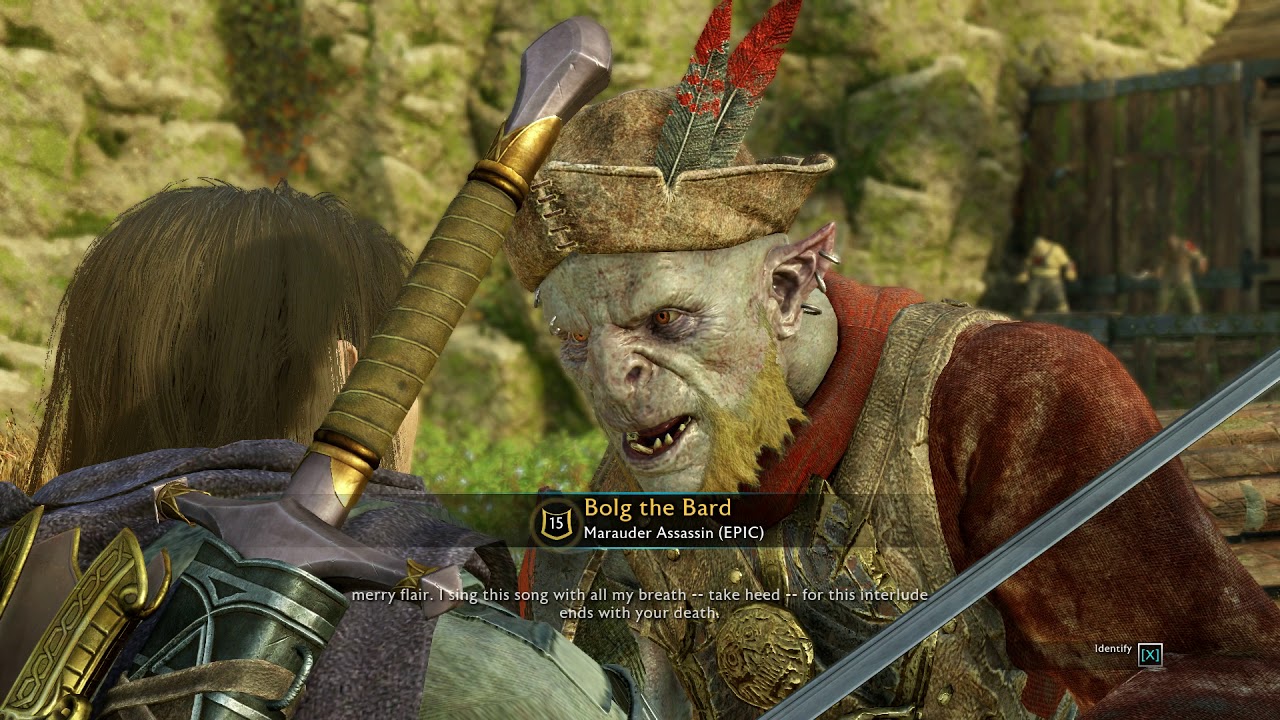
The orcs are their own unique faction in the game’s world, and every single orc has their own unique appearance, personality and name, all of which are procedurally generated, with a few exceptions for orcs that are part of the plot and will appear in every player’s game. Some of them even have unique voices and voice actors, like the Agonizer, who is voiced (somewhat not convincingly) by Kumail Nanjiani. The voices can be especially entertaining, particularly ones that speak in limericks or sing you a song about how they’re going to kill you. Yes, I’m serious.

But the real showstopper of the game is the Nemesis System, which is tied into the orcs’ behavior and gives them so much more spice than just a random video game enemy for you to tear apart. You see, one of the major things about the protagonist of the game – who is honestly so generic that I completely forgot his name, and frankly I don’t even think it matters – is that he is resurrected whenever he dies. He can be killed, but he always comes back. And that is what allows the Nemesis System to work its magic.
This time, it’s personal
The Nemesis System means that when any random orc grunt kills you, is killed by you, or defeats you in combat, there’s a chance for something unique to happen: it becomes your personal nemesis. It gains a unique title and appearance, levels up, acquires new abilities, and may even have some new trait that depends on how you fought it and what happened in the battle. It hunts you down, taunts you by name, remembers your previous battles, and always seeks to exact revenge on you personally. And the more times you encounter that nemesis from then on, the more it changes, and the more powerful it becomes – even being able to eclipse you.
And trust me when I tell you that there are so many possibilities for your own unique Nemesis, so much so that even after playing the game for days and encountering upwards of a hundred different Nemeses, I never got bored of them and was always delighted to encounter a new one. Even when I was killed by my Nemesis, I still enjoyed seeing how the orc reacted and changed, and hunting it down later became more entertaining to me than the actual plot of the game, which honestly pales in comparison to the wild fun of the randomly generated Nemesis stories. I didn’t even finish the first level of the game for a week because I was so enamored with chasing down my customized orc antagonists and seeing what new ones appeared.
If you kill an orc by chopping off its arm, it might just come back with a cybernetic limb and the title “The Claw.” If an orc manages to outwit you three times, it becomes “The Uncatchable” and gains a nasty ego. If you poison an orc to death, it gains “The Blight” title and becomes physically deformed. Orcs that have the “Death Defying” ability will keep coming back even when you think you’ve killed them, and orcs can even be “Arrow Proof,” “Frost Proof” or have other incredibly nasty powers and perks. Orcs can even have phobias and weaknesses, such as a crippling weakness to poison or a fear of bees – which a clever player can learn to use against them. They can also have some incredibly hilarious appearances, voices and names. And they’re all so different that it never gets old.
In my own game, for example, I once encountered, in the span of a single play session:
- A stealthy poison rogue orc who snuck around in the shadows, taunted me from afar, and shot venomous arrows at me.
- A really nice and friendly orc who just wanted to be buddies, and legitimately sounded bummed out that he had to try and kill me. I felt a little bit bad about lopping his head off, can’t lie.
- A sensual creepy orc with a high voice who loudly proclaimed that he wanted to desecrate my corpse. Yeah, I’m serious about that too. And the worst part is, he actually managed to kill me. So, y’know. My poor resurrecting ranger’s corpse may have suffered a much worse fate than death.
Telling your stories
The biggest strength of the Nemesis system, in my opinion, is how perfectly it enables organic storytelling. I honestly would claim that it does storytelling better than the actual plot of the game. The developers of the game even admit that they designed the Nemesis system so that you could tell your friends stories about it, tweaking dialogue so that it would make for funnier tall tales of your orcish antagonists.
There are so many games that claim to produce “stories you can tell your friends,” but what point is there in telling your friend about a cutscene in a game that literally everyone who plays the game will experience? How can I turn a boring raid battle into an exciting story or a “unique personal narrative”?

The Nemesis system, on the other hand, is positively ripe for storytelling. Everybody will have their own unique Nemeses, and encountering them is always memorable, even the small ones. I don’t remember my favorite moments from Destiny or Warframe, and I couldn’t tell you any long-winded personal stories about Anthem or Fallout 76, but I remember almost every one of my Shadow of War Nemeses, even the minor ones that only lasted a few fights, and I could tell you about all of the adventures and follies that went with them.
There are so many stories that can arise from your clashes and duels with your Nemesis, and so many potential Nemeses that can result from the choices you make – which is what makes them so unique and effective as storytelling devices. I’ve heard my friends talk about orcs who were scarred when they dealt them poison damage, becoming twisted mutant monstrosities who hunted them down for revenge; orcs who were shamed by their clan for letting the player defeat them and later came back covered in tattoos to regain their honor; and so many more. The possibilities are incredible, and functionally almost endless. Even now, researching for this post, I keep finding new potential Nemeses, all with their own unique traits and chances to occur.
Which brings me to my own Nemesis story.
The story of my favorite Nemesis
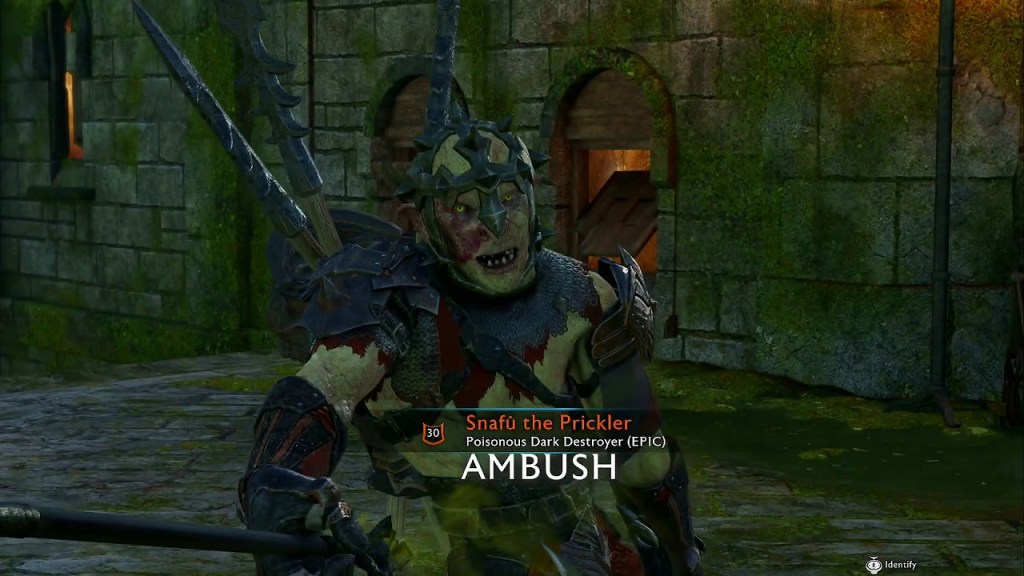
In my first Shadow of War playthrough, back when I first bought the game and hadn’t yet gotten through the story or acquired the domination ability, I was killed by a random orc minion in the first world. He got a lucky shot on me after I’d been softened up by fighting an ambusher Nemesis, and oh boy, did it suck to get killed by a complete nobody. I remember staring in horror at my bloody body on the screen as the orc gloated over my corpse, saying how his kill would finally bring him glory among his brethren, and then he was promoted and became a fire-wielding orc who wore a flaming crown and used flame weapons in combat. He even got a new title: “The Tark Slayer.” (I guess since I’m a Tark? I never did figure that part out.)

Since he was the first orc who had ever killed me at that point, I decided to hunt him down and get my revenge. At this point I was still new to the game and didn’t fully understand the Nemesis system – I just knew that this random orc had killed me and that he was really fucking smug about it, and that if I didn’t stop him now he might get more powerful later on.
I finally got my sweet revenge when I tracked him down on the castle ramparts and cut off his arm, figuring that would kill him for sure. He fell down and seemed to die, and since I was, again, new to the game and didn’t know that beheading is the only way to guarantee a permanent kill, I figured that was the last I would ever see of the Tark Slayer.
But later on, right in the middle of a giant horde battle that wasn’t going my way, I heard a trumpet blaring and got a nasty surprise. My old friend had come back as a big nasty brute called “The Machine,” with a prosthetic metal-forged arm and a vendetta, ready for revenge. He became my recurring nemesis eight or nine times throughout the game, always showing up at the absolute worst time and gaining new annoying powers, and each time I would wound another part of his body and he would become more and more mechanical and cyborg-looking, even gaining metal implants on his face.
Our grand rivalry finally ended when, after many failed attempts to thwart this increasingly terrifying orc, I figured out his weakness, chopped off his head and finished him off for good. But even then, I was so paranoid of him coming back and crashing one of my orc-killing parties that I braced myself to hear his taunting monologue every time I got into a horde battle from that point onward. Just in case he had survived.
That’s how effective and incredible the Nemesis system can be. It’s amazing, and I still tell that whole saga to my friends as one of my favorite gaming stories. Because the big strength of the system is that it lets you tell these unique personal narratives, ones that will be unlike anybody else’s. And I love when games do that. I think that’s so special.
How does it work?
So how did the developers accomplish this system? What are the parts that make it work?
The answer, in brief: A mix of procedural generation, tons of hard work, and very clever mathematics.
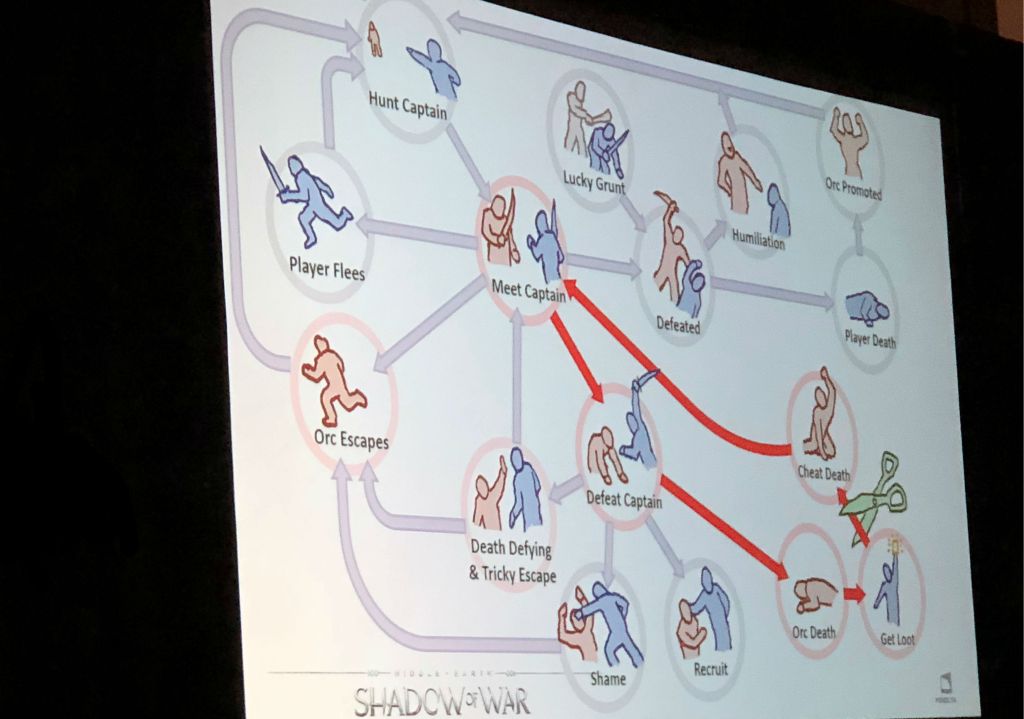
First, there’s the Player Interaction Score, or PIS. This score measures your relationship with every single orc in the game, and the higher an orc’s PIS score – that is, the more the player interacts with them and seems interested in them – the more likely that orc is to “cheat death” and become your next recurring Nemesis. This way, the act of an orc becoming your Nemesis is more rare and special, because it only happens to a few select orcs that the player cares about, not every single random orc grunt in the game.
However, a high PIS doesn’t guarantee that an orc has permanent Plot Armor so that it can keep coming back, and eventually, if the player has just fought that orc too many times, the immunity gets turned off under the hood and the player is allowed to kill the orc and put a stop to the Nemesis for good. That way you can finally get the satisfaction of murdering them after all the development they’ve gone through and all the times they’ve thwarted you, but they still get to terrorize you a few times and feel like a powerful antagonist.
There’s also orc memory, which enables each orc to remember things like whether you fled from them in combat – enabling them to taunt you about it on your next encounter. This also allows them to “remember” you cutting off their limbs, burning them, poisoning them, or whatever else you do to them, so that they can incorporate that into their appearance and personality from that point onward. This is what makes the orcs feel organic and alive, like they’re living creatures who have memories and thoughts of their own, rather than just a bunch of numbers and dice rolls.
Finally, there’s the procedural generation. Like I said earlier, every orc gets their own unique generated appearance, voice, name, titles, abilities, and weaknesses. But how does this work under the hood? How many possibilities are really available?
Turns out it’s exactly how you would expect. The game simply has a crapton of premade assets – costumes, hats, voices, behavior scripts – and then it randomly mixes them together for each orc, adjusting them whenever a unique thing happens to that orc. There’s not much more to it than that, and I have to really admire the dedication of the game designers to making so many possible assets to choose from, because holy crap, that must have taken a lot of work! Kudos! To make every single orc feel so differentiated, even after multiple playthroughs when you start to see the patterns, is a truly monumental task.

Conclusion
I would kill for any of the procedural generation systems I’m working on for my games to turn out as incredible as the Nemesis System. It’s probably the second-best example I’ve seen of really clever, well-implemented and innovative procedural generation in video games. It enriches the game, meshes with the narrative and feels completely natural – and it adds true meaning to the mechanic of Talion being able to resurrect himself after being killed, instead of having that just be handwaved away as a “video game thing.”
But wait. What’s the best example of well-implemented procedural generation in video games, you ask? What is this mysterious other game of which you speak?
Next time, we discuss No Man’s Sky, and why its procedural generation system does everything wrong that the Nemesis System does right. Stay tuned!
 Top Hat Games